
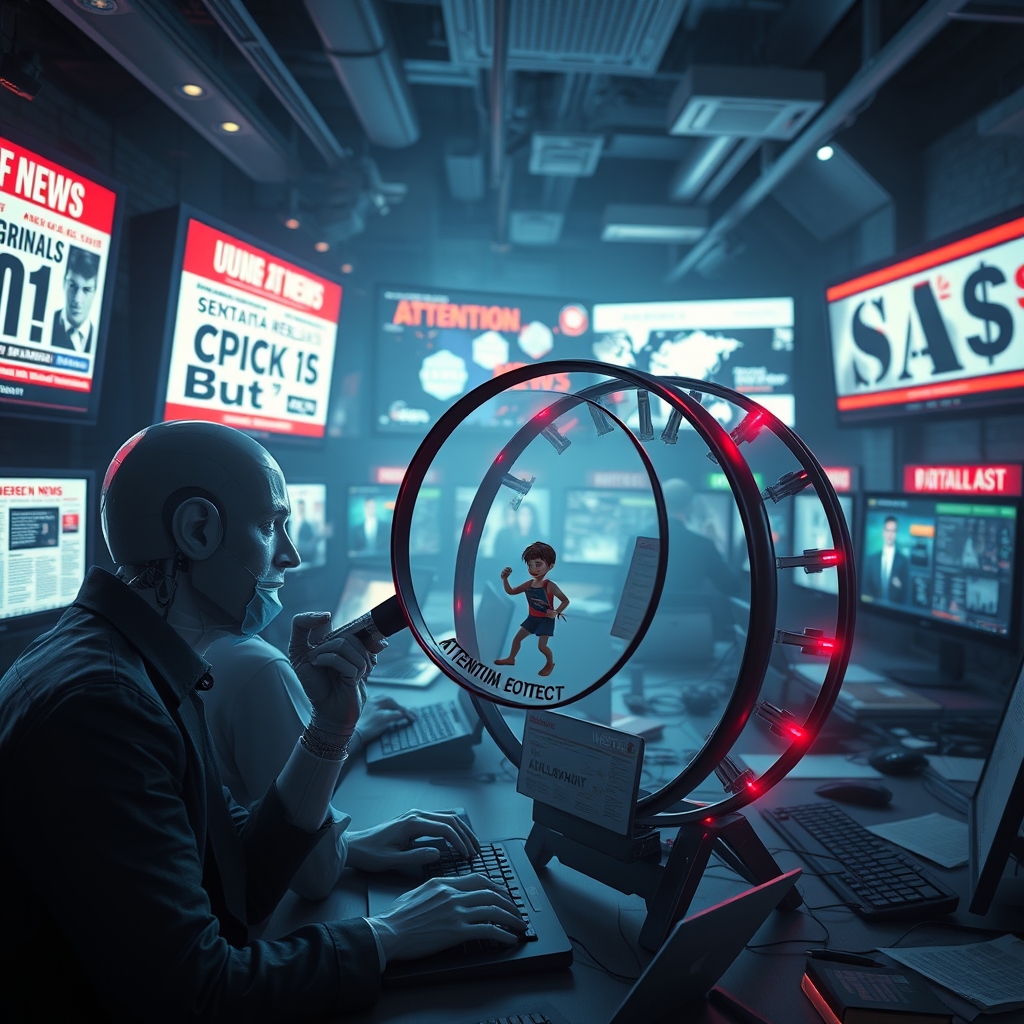
Ah, the news business—where the line between journalism and performance art has been so thoroughly erased that even the most seasoned reporters now double as improv comedians. You’d think in an era where information is more accessible than ever, we’d be drowning in enlightenment. Instead, we’re drowning in a sea of hot takes, breathless headlines, and enough outrage to power a small country. But hey, at least the ads are targeted, right?
The Death of Nuance (And the Birth of the Hot Take Industrial Complex)
Remember when news was something you consumed to stay informed? Pepperidge Farm remembers. Now, it’s a never-ending buffet of opinions masquerading as facts, served with a side of moral panic. The hot take industrial complex has turned every minor event into a full-blown existential crisis, because nuance doesn’t drive engagement. Nuance doesn’t make you click, share, or scream into the void of your Twitter feed. Nuance is the enemy of the algorithm, and the algorithm is the only god the news business worships these days.
Take, for example, the latest non-scandal scandal. A celebrity said something mildly controversial? Cue the think pieces, the Twitter threads, the cable news panels where pundits debate whether this is the end of civilization as we know it. Spoiler alert: it’s not. But why let the truth get in the way of a good ratings boost? The news cycle moves at the speed of light, and if you blink, you’ll miss the next manufactured outrage. It’s like watching a never-ending game of whack-a-mole, except the moles are your sanity.
The Algorithm: Because Human Judgment is Overrated
Gone are the days when editors decided what was newsworthy. Now, that honor belongs to the algorithm—a faceless, soulless entity that knows you better than your own mother. It doesn’t care about truth, context, or the fragile state of your mental health. All it cares about is keeping you glued to your screen, scrolling, clicking, and consuming. And boy, does it know how to push your buttons.
Did you linger a little too long on that article about political corruption? Congratulations, your feed is now a dystopian hellscape of corruption, scandal, and doom. Did you watch one too many videos of cute puppies? Prepare for an onslaught of puppy content, because the algorithm has decided that’s all you’re good for. It’s like being trapped in a never-ending episode of Black Mirror, except the only thing being surveilled is your attention span.
The algorithm doesn’t just shape what you see—it shapes how you think. It reinforces your biases, amplifies your fears, and turns every minor disagreement into a full-blown culture war. And the news business? Oh, they’re more than happy to play along. Why bother with balanced reporting when you can just feed the beast and watch the engagement numbers soar?
Journalism’s Identity Crisis: Are We Entertainers or Reporters?
Once upon a time, journalism was a noble profession. Reporters were the watchdogs of democracy, holding the powerful accountable and shining a light on the truth. Now? They’re just another cog in the content machine, churning out clickable, shareable, and above all, profitable stories. The line between news and entertainment has blurred so much that it’s practically invisible.
Take a look at your favorite “news” outlet. Are they reporting on important issues, or are they just giving you what you want to hear? Are they challenging your worldview, or are they reinforcing it? Chances are, it’s the latter. The news business has figured out that people don’t want to be informed—they want to be validated. And if that means sacrificing a little thing called integrity, well, that’s just the cost of doing business.
And let’s not forget the rise of the “brand journalist.” These are the folks who’ve traded in their press badges for influencer status, turning the news into just another form of content marketing. They’re not reporting the news—they’re curating it, packaging it, and selling it to the highest bidder. Because in the news business, everything is for sale, including your trust.
The Attention Economy: Where Your Time is the Currency and You’re Always Broke
In the attention economy, your time is the most valuable currency. And the news business? They’re the bankers, the loan sharks, and the guys who break your knees if you don’t pay up. They’ve turned news consumption into a full-contact sport, where the only way to win is to keep clicking, keep scrolling, and keep feeding the machine.
But here’s the thing: you’re not the customer. You’re the product. Your attention is what’s being bought and sold, and the news business is just the middleman. They package your outrage, your fear, and your curiosity into neat little bundles and sell them to advertisers. And the best part? You don’t even get a cut of the profits. You’re the unpaid intern, working overtime to keep the machine running, while the suits in the corner office count their money and laugh all the way to the bank.
So the next time you find yourself doomscrolling at 2 a.m., ask yourself: who’s really benefiting from this? Is it you, or is it the news business? Because in this game, the house always wins. And you? You’re just along for the ride, clutching your phone like it’s a life preserver in a sea of nonsense.
The news business didn’t just sell its soul—it sold yours too. And the worst part? You handed it over willingly, one click at a time. But hey, at least the ads are personalized. That’s something, right?
You may also like
-
The News Business: Where the Only Thing More Infinite Than the Scroll Is Your Diminishing Faith in Humanity
-
The News Business: Where the Only Thing More Exhausting Than the News Cycle Is Pretending You Understand It
-
The News Business: Where the Only Thing More Predictable Than the Headlines Is Your Indignation
-
The News Business: Where the Truth is a Commodity and Your Brain is the Market
-
The News Business: Where the Only Thing More Broken Than the System Is Your Attention Span