
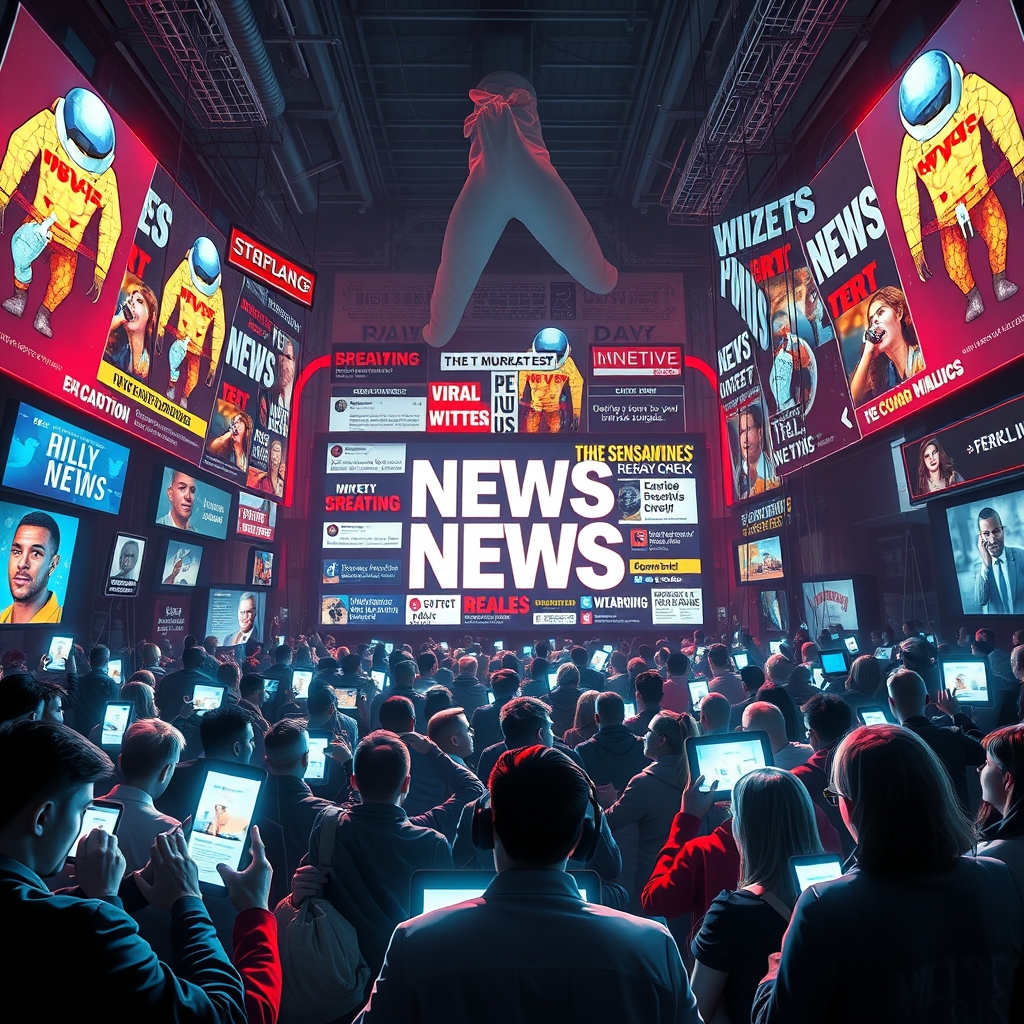
Oh, the news business—where the line between journalism and infomercials is thinner than a Kardashian’s skin after a fresh round of filters. You’d think in an era where information is literally at our fingertips, we’d be drowning in well-researched, nuanced, and unbiased reporting. Instead, we’re drowning in a sea of hot takes, outrage porn, and whatever viral nonsense the algorithm gods deem worthy of our precious, ever-shrinking attention spans. But hey, at least the ads are tailored to our deepest insecurities, right?
The Illusion of Choice: Why 500 Channels Still Feel Like One
Remember when cable TV promised us 500 channels and the freedom to watch whatever we wanted? Fast forward to today, and we’ve got 500 news outlets, all screaming the same thing in slightly different fonts. Whether it’s Fox News, CNN, MSNBC, or your uncle’s Facebook feed, the script is eerily similar: fear, division, and just enough half-truths to keep you coming back for more. It’s like a buffet where every dish is just slightly reheated leftovers from yesterday’s outrage.
The real kicker? The illusion of choice is just that—an illusion. Behind the scenes, a handful of conglomerates own the majority of these outlets, ensuring that the narrative stays as homogenized as a gallon of store-brand milk. But sure, keep telling yourself you’re getting the full spectrum of opinions while you scroll through your curated echo chamber. The algorithm knows what you want to hear, and it’s not interested in challenging your worldview. Why would it? Outrage is the new currency, and you’re the ATM.
The Click Economy: Where Outrage is King and Nuance is a Peasant
In the news business, clicks are the new gold standard, and outrage is the pickaxe that mines them. Why bother with balanced reporting when you can slap a sensational headline on a half-baked story and watch the engagement roll in? The formula is simple: take a kernel of truth, douse it in hyperbole, and serve it up with a side of moral panic. Bonus points if you can make it about politics, because nothing drives engagement like a good old-fashioned culture war.
And let’s not forget the rise of the “hot take industrial complex,” where pundits and influencers alike compete to see who can be the most polarizing. Nuance? That’s cute. Context? Who has time for that when there’s a tweet to dunk on? The news cycle moves at the speed of light, and if you pause for even a second to fact-check or—God forbid—consider the other side, you’ll be left in the dust. The goal isn’t to inform; it’s to provoke, to keep you hooked, to make sure you’re too angry to look away. Mission accomplished, I’d say.
The Death of Journalism (And the Rise of the Content Farmer)
Once upon a time, journalism was a noble profession. Reporters dug for the truth, held the powerful accountable, and gave a voice to the voiceless. Now? Now it’s a race to the bottom, where the fastest typist with the most inflammatory headline wins. The term “journalist” has been watered down to include anyone with a Twitter account and a strong opinion, regardless of whether that opinion is backed by facts, ethics, or even basic common sense.
Enter the content farmer: the modern-day equivalent of a fast-food worker, churning out low-effort, high-volume “news” designed to fill the endless void of the internet. These are the folks who turn a local car accident into a national crisis, who spin a celebrity’s bad hair day into a existential threat to democracy. They’re not journalists; they’re clickbait artisans, and their medium is your shrinking attention span. But hey, at least they’re keeping the ad revenue flowing, right?
The Algorithm’s Gambit: How Your Brain Became the Product
Ah, the algorithm—the invisible hand guiding your every scroll, like, and share. It knows you better than you know yourself, predicting your next move with eerie accuracy. And what does it want? Not to enlighten you, not to challenge you, but to keep you engaged just long enough to serve up another ad. The news business isn’t about informing the public; it’s about monetizing your eyeballs, one outrage cycle at a time.
Think about it: when was the last time you read a news article that actually changed your mind? That made you pause and reconsider your stance on an issue? If you’re struggling to remember, don’t worry—you’re not alone. The algorithm isn’t designed to broaden your horizons; it’s designed to reinforce your existing beliefs, to keep you in your lane, to make sure you’re always just angry enough to keep scrolling. And the news business? It’s more than happy to play along, because in the end, your brain is just another product on the shelf.
The Future of News: More of the Same, But Louder
So what’s next for the news business? More of the same, but with even less subtlety. As long as there’s money to be made from outrage, the cycle will continue, spinning faster and faster until we’re all just a blur of hot takes and half-truths. The rise of AI-generated content will only accelerate this trend, churning out articles at a pace that even the most dedicated content farmer couldn’t dream of. Soon, we’ll have news bots arguing with each other on Twitter, and honestly, we’ll probably engage with that too.
But here’s the thing: the news business isn’t going to change unless we do. As long as we keep clicking, keep sharing, keep feeding the machine, it will keep serving us the same junk food for the brain. The question is, are we willing to demand better? Or are we content to sit back, scroll, and let the algorithm decide what we think? The choice is ours—but don’t hold your breath waiting for the news business to make it easy for us.
In the end, the news business is just a reflection of us: flawed, messy, and endlessly distracted. We get the media we deserve, and right now, that’s a 24/7 circus of outrage, sensationalism, and clickbait. But if we ever decide to demand more—to value truth over engagement, nuance over noise—maybe, just maybe, the news business will finally have to step up its game. Until then, grab your popcorn and enjoy the show. It’s going to be a wild ride.
You may also like
-
The News Business: Where the Only Thing More Infinite Than the Scroll Is Your Diminishing Faith in Humanity
-
The News Business: Where the Only Thing More Exhausting Than the News Cycle Is Pretending You Understand It
-
The News Business: Where the Only Thing More Predictable Than the Headlines Is Your Indignation
-
The News Business: Where Your Outrage is the Product and You’re the Unpaid Intern
-
The News Business: Where the Only Thing More Broken Than the System Is Your Attention Span