
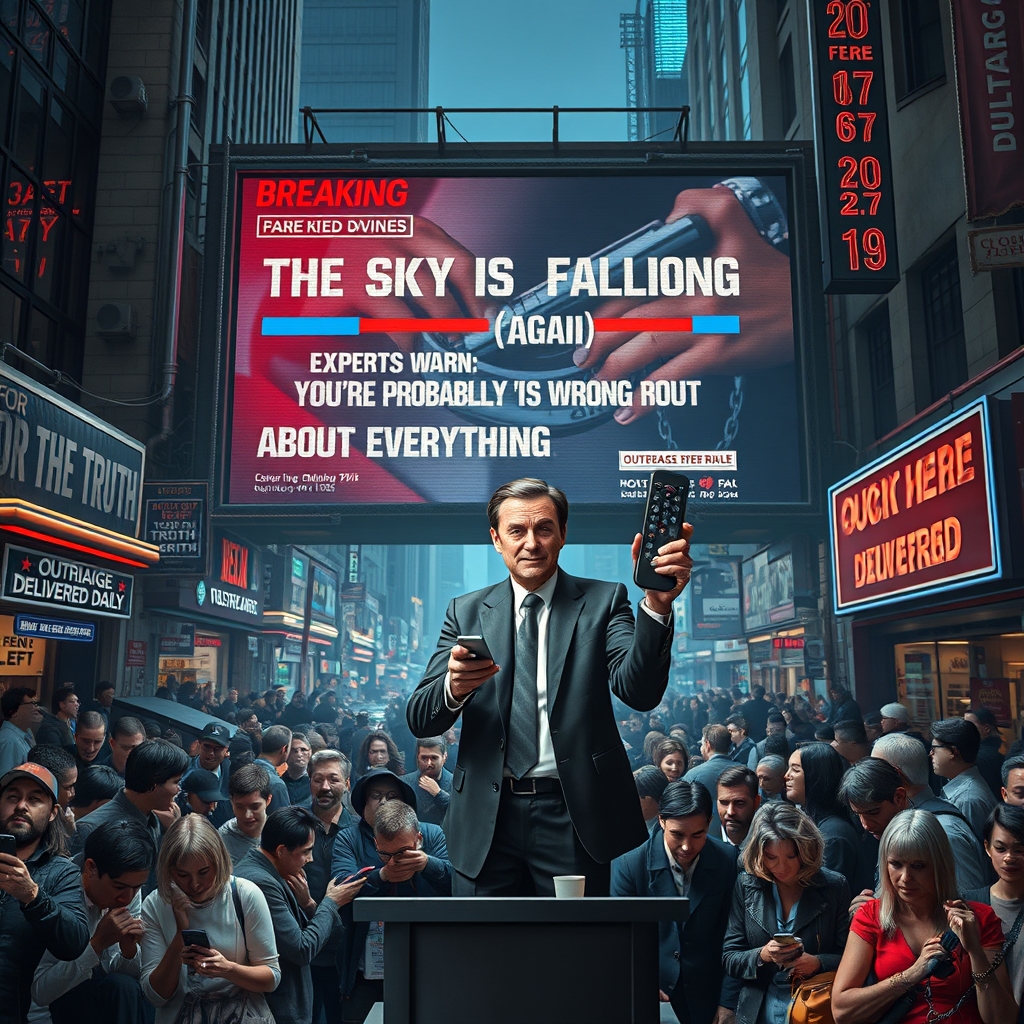
Ah, the news business—where the fourth estate meets the stock market, and somehow, the only thing that gets reported with any consistency is the ever-rising cost of a latte in Manhattan. If you’ve ever wondered why your morning news feed feels less like information and more like a poorly written dystopian novel, congratulations, you’ve stumbled upon the great unspoken truth: the news isn’t here to inform you. It’s here to sell you. And not just ads for erectile dysfunction pills or mattresses that promise to solve all your problems (spoiler: they won’t). No, it’s selling you something far more insidious—your own attention, repackaged as outrage, fear, or that sweet, sweet dopamine hit of feeling smarter than the guy who still thinks the Earth is flat.
The Algorithm of Outrage: Because Nuance is Boring
Let’s talk about algorithms, those digital overlords that have decided your brain is their personal playground. News outlets, bless their profit-driven hearts, have figured out that nothing drives engagement quite like making you angry. Or terrified. Or both. Why report on a complex geopolitical issue when you can just scream about how the other side is literally Hitler? Nuance is for losers who don’t understand the beauty of a good, old-fashioned Twitter mob. And so, the news cycle becomes a never-ending carousel of outrage, where every story is either the end of democracy or the second coming of Christ, depending on which side of the aisle you’ve been algorithmically assigned to.
Take, for example, the time a major news network spent three days breathlessly covering a celebrity’s wardrobe malfunction while a war raged on in the background. Was it newsworthy? Of course not. But it was engaging. And engagement, my friends, is the holy grail of the news business. Because engagement means clicks, and clicks mean ad revenue, and ad revenue means the CEO gets to buy another yacht. Priorities, people.
The Death of Journalism (And the Birth of Content)
Once upon a time, journalism was a noble profession. Reporters dug for the truth, held power to account, and occasionally got thrown in jail for their troubles. Now? Now it’s just “content.” And content, unlike journalism, doesn’t require facts, integrity, or even basic coherence. It just requires eyeballs. Why bother sending a reporter to cover a local city council meeting when you can just slap together a listicle titled “10 Things Your Local Politician Doesn’t Want You to Know (Number 7 Will Shock You!)”? Spoiler: Number 7 is never actually shocking. It’s usually something like “They eat lunch” or “They have a dog.”
The rise of “content” has also given birth to a new breed of journalist: the influencer-reporter. These are the folks who treat the news like a TikTok trend, complete with dramatic pauses, overly earnest facial expressions, and a complete disregard for anything resembling depth. Their job isn’t to inform; it’s to perform. And if that performance happens to include a tearful monologue about how much they “care,” well, that’s just icing on the engagement cake.
The Illusion of Choice: Why All News Sounds the Same
You’d think that with hundreds of news outlets at your fingertips, you’d have a veritable buffet of perspectives to choose from. But no. Instead, you get the same story, regurgitated in slightly different flavors, like a fast-food menu designed by committee. Whether you’re watching Fox News, MSNBC, or the local public access channel, the script is always the same: “Here’s a thing that happened. Here’s why it’s either the best thing ever or the worst thing ever. Now here’s a panel of people who will yell at each other about it for 20 minutes.”
The reason for this homogeneity isn’t some grand conspiracy (though, let’s be real, conspiracies are way more fun). It’s just good old-fashioned capitalism. News outlets don’t want to take risks. They want to give you exactly what you already believe, because that’s what keeps you coming back. And if that means turning every story into a binary choice between good and evil, well, that’s just the cost of doing business. After all, why challenge your audience when you can just confirm their biases and send them on their way, secure in the knowledge that they’ll be back tomorrow for another helping of the same?
The Future of News: Where Do We Go From Here?
So, what’s the solution? Should we all just give up and resign ourselves to a future where the news is nothing more than a series of increasingly desperate attempts to grab our attention? Well, no. But we also shouldn’t pretend that the answer is as simple as “just read better sources.” Because let’s be honest, even the “good” news outlets are playing the same game. They might not be as blatant about it, but they’re still chasing clicks, still pandering to algorithms, still treating the news like a product rather than a public service.
The real solution, if there is one, is to demand better. Not just from the news outlets, but from ourselves. We have to stop treating the news like entertainment. We have to stop rewarding outrage with our attention. And most importantly, we have to stop pretending that the news business is anything other than what it is: a business. A business that, like all businesses, is primarily concerned with making money. And if that means selling us fear, division, and the occasional feel-good story about a dog that can ride a skateboard, well, that’s just the price we pay for living in a world where the truth is optional, but the ads are mandatory.
So the next time you find yourself doomscrolling through yet another apocalyptic headline, take a moment to ask yourself: who benefits from this? Spoiler: it’s not you. It’s the people who are selling you the illusion that you’re informed, while all you’re really doing is feeding the machine. And the machine, my friends, is always hungry.
You may also like
-
The News Business: Where the Only Thing More Infinite Than the Scroll Is Your Diminishing Faith in Humanity
-
The News Business: Where the Only Thing More Exhausting Than the News Cycle Is Pretending You Understand It
-
The News Business: Where the Only Thing More Predictable Than the Headlines Is Your Indignation
-
The News Business: Where Your Outrage is the Product and You’re the Unpaid Intern
-
The News Business: Where the Truth is a Commodity and Your Brain is the Market