
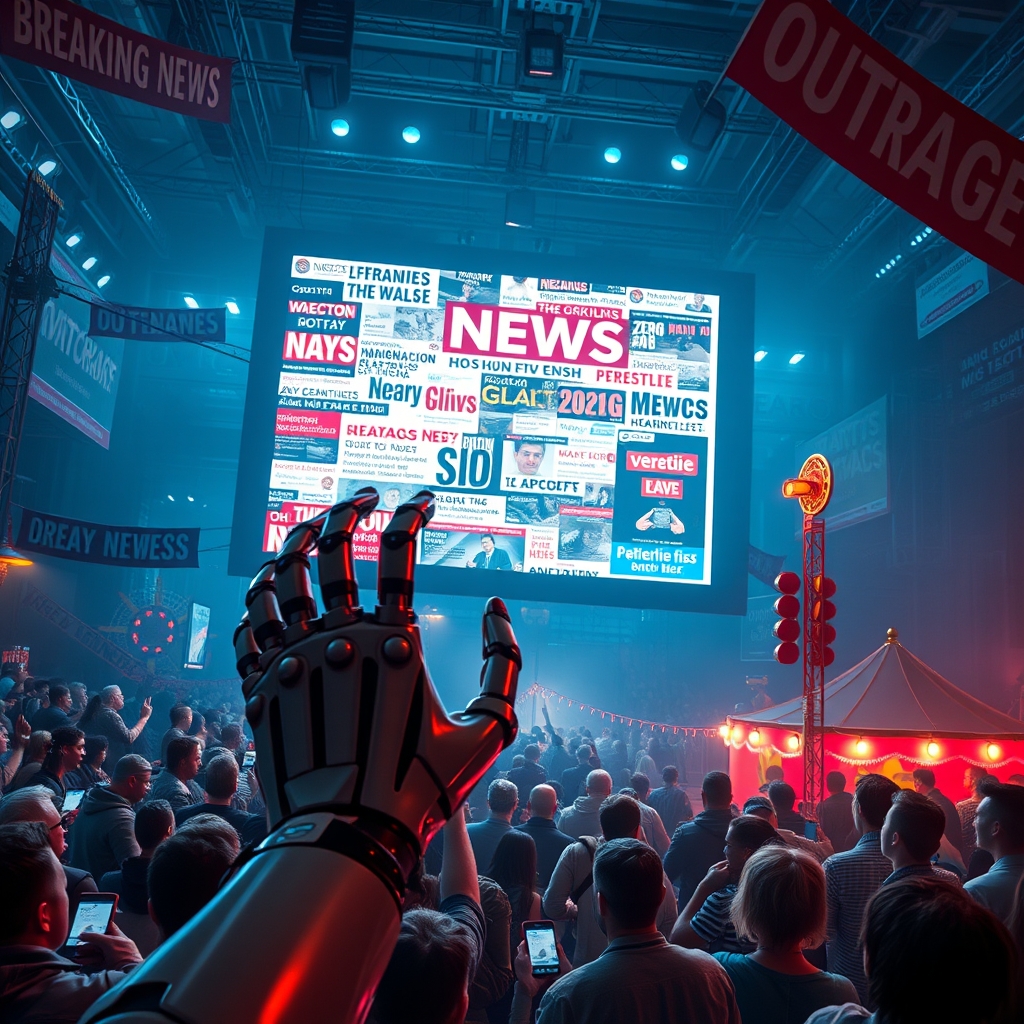
Oh, the news business—where the line between journalism and performance art has been so thoroughly erased that even the most seasoned reporters now double as improv comedians. Or at least, that’s what they’d have you believe if you tuned into any major outlet on any given day. Because in this glorious era of information overload, the news isn’t just a product; it’s a spectacle, a circus, a never-ending reality show where the stakes are your attention span and the prize is your soul—or at least your ad revenue.
The Death of Nuance (And the Birth of the Hot Take Industrial Complex)
Remember when news was something you consumed to stay informed? How quaint. These days, it’s more like a competitive sport where the goal isn’t to enlighten but to out-scream the other guy. Nuance? That’s for losers. Context? A relic of a bygone era. The modern news cycle thrives on hot takes—those spicy, often half-baked opinions served up like fast food because, let’s face it, nobody has the time (or patience) for a five-course meal of actual analysis.
Take, for example, the latest political scandal. In the old days, you might’ve gotten a deep dive into the policy implications, the historical context, and maybe even a quote from an expert who didn’t sound like they were reading from a Mad Libs template. Now? You get a 90-second segment where two pundits yell at each other while a chyron at the bottom of the screen screams, “IS THIS THE END OF DEMOCRACY?!” Spoiler alert: It’s not. But why let facts get in the way of a good panic?
The Algorithm’s Guide to Human Emotion
If you’ve ever wondered why your news feed is a never-ending carousel of doom, outrage, and the occasional cute animal video (to keep you from spiraling into existential despair), look no further than the almighty algorithm. These digital overlords have cracked the code on human psychology: we’re wired to pay attention to things that make us angry, scared, or just plain confused. And the news business? Oh, they’ve taken that lesson to heart.
Gone are the days when a newspaper’s front page was a carefully curated selection of the day’s most important stories. Now, it’s whatever will get the most clicks, shares, and comments—preferably in that order. The result? A media landscape where the most trivial, sensational, or downright bizarre stories rise to the top like cream in a vat of spoiled milk. And if you think that’s bad, just wait until the AI-generated news bots take over. At least humans have the decency to feel a little guilty about peddling nonsense. Bots? Not so much.
Journalism as a Service (Because Who Needs Integrity When You Have Subscribers?)
In the grand tradition of capitalism, the news business has fully embraced the subscription model. Why rely on advertising revenue when you can guilt-trip your audience into paying for “quality journalism”? It’s a brilliant strategy, really. First, you convince people that the news is so vital to their daily lives that they simply can’t live without it. Then, you dangle the carrot of “unbiased reporting” just out of reach, behind a paywall that’s just high enough to be annoying but not so high that it deters the truly committed.
And let’s not forget the crowdfunding angle. Nothing says “I care about the truth” like a GoFundMe for a journalist’s latest investigative piece. Because if there’s one thing the news business has taught us, it’s that the only thing standing between us and the collapse of democracy is a few bucks from some well-meaning strangers on the internet. Sure, it’s a far cry from the days when newspapers were funded by actual, you know, revenue, but who needs sustainability when you’ve got passion?
The Fine Art of Manufactured Outrage
If there’s one thing the news business has perfected, it’s the art of turning molehills into mountains—or, more accurately, into full-blown Everests of indignation. A celebrity said something mildly controversial? Cue the think pieces, the Twitter threads, and the inevitable “cancellation” that never actually happens. A politician made a gaffe? Prepare for 72 hours of non-stop coverage, complete with dramatic reenactments and a panel of experts dissecting every possible interpretation of the offending statement.
And the best part? The outrage is entirely manufactured. The news cycle doesn’t reflect reality; it creates it. A story that might’ve been a blip on the radar a decade ago now dominates the conversation for days, not because it’s important, but because it’s engaging. And by engaging, we mean it makes you so mad that you can’t look away. It’s like a car crash, except instead of rubbernecking, you’re doomscrolling, and instead of a twisted metal wreck, you’re left with a twisted sense of what actually matters.
The Future of News: Brought to You by Robots (And Your Short Attention Span)
So what’s next for the news business? If current trends are any indication, we’re hurtling toward a future where AI-generated content is indistinguishable from the real thing—assuming you can still tell the difference. Already, we’ve got algorithms churning out sports recaps, financial reports, and even entire articles that sound like they were written by a human (if that human had the emotional range of a toaster). And as AI gets smarter, the line between man and machine will blur even further, until one day, you’ll read a breaking news alert and wonder: was this written by a person, or just a very convincing chatbot?
But hey, at least we’ll have more time to focus on what really matters: arguing with strangers on the internet about whether pineapple belongs on pizza. Because in the end, the news business isn’t about informing the public; it’s about keeping us distracted, divided, and desperate for the next hit of dopamine that comes from clicking “refresh” one more time. And if that’s not the most depressing thing you’ve read all day, well, you clearly haven’t been paying attention.
The news business didn’t just adapt to the digital age—it weaponized it. And now, we’re all just collateral damage in the war for clicks, shares, and the ever-elusive engagement metric. So the next time you find yourself doomscrolling at 2 a.m., ask yourself: is this really what you signed up for? Or are you just another cog in the machine, feeding the beast that’s slowly eating your attention span alive? The answer, unfortunately, is probably both.
You may also like
-
The News Business: Where the Only Thing More Infinite Than the Scroll Is Your Diminishing Faith in Humanity
-
The News Business: Where the Only Thing More Exhausting Than the News Cycle Is Pretending You Understand It
-
The News Business: Where the Only Thing More Predictable Than the Headlines Is Your Indignation
-
The News Business: Where Your Outrage is the Product and You’re the Unpaid Intern
-
The News Business: Where the Truth is a Commodity and Your Brain is the Market