
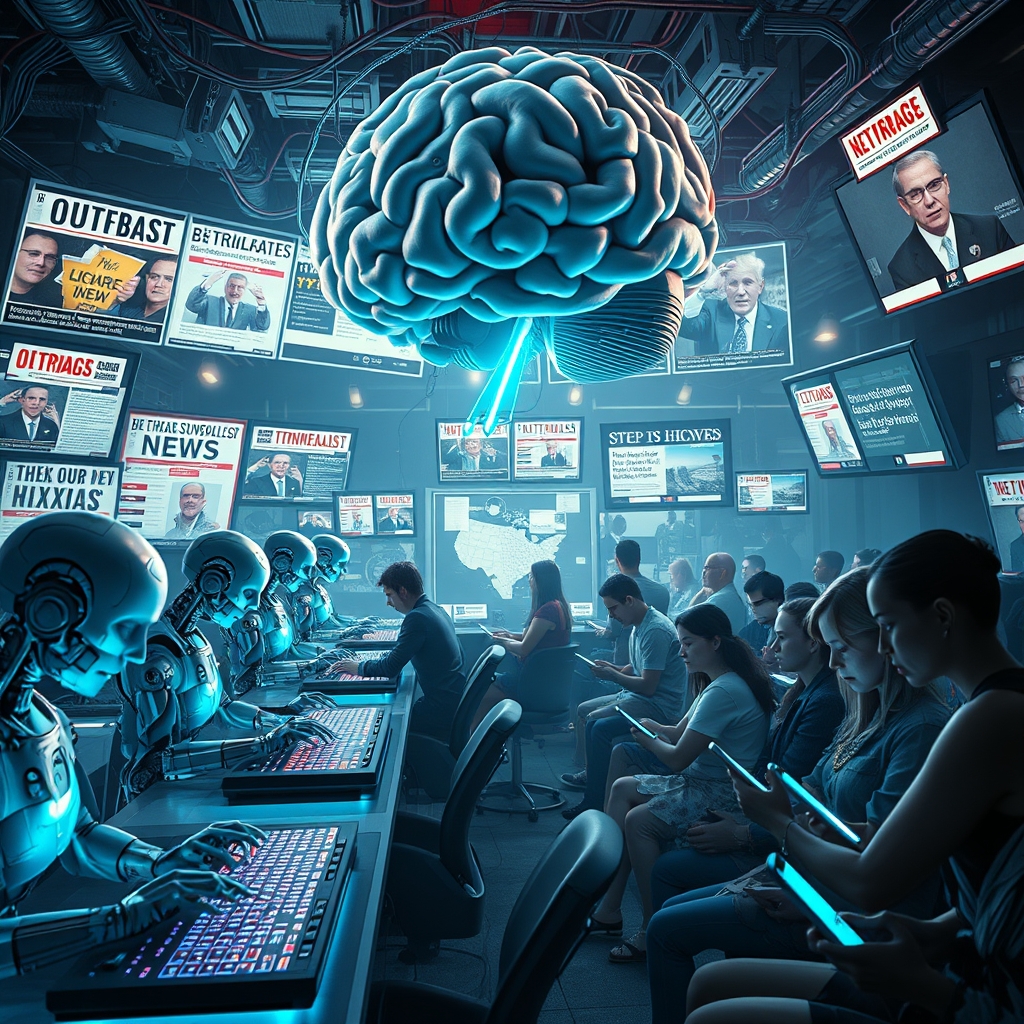
Oh, the news business—where the pursuit of truth has been replaced by the pursuit of engagement metrics, and integrity is just a quaint relic of a bygone era. If you’ve ever wondered why your news feed looks like a chaotic mix of celebrity gossip, political outrage, and cat videos, congratulations, you’ve stumbled upon the modern marvel that is the news industry. It’s not about informing the public anymore; it’s about keeping you hooked, outraged, and coming back for more like a lab rat in a never-ending maze of clickbait.
The Algorithm: The Puppet Master We All Love to Hate
Let’s talk about the real star of the show: the algorithm. This digital overlord decides what you see, what you don’t see, and what you’ll be outraged about by lunchtime. It’s not a journalist, it’s not a fact-checker, and it certainly doesn’t care about nuance. What it does care about is keeping you glued to your screen, scrolling endlessly like a zombie in search of its next dopamine hit. The algorithm doesn’t discriminate—it’ll feed you a heartwarming story about a dog saving a kitten one minute and a sensationalist piece about a politician’s latest scandal the next. Variety is the spice of life, after all, especially when it keeps you engaged just long enough to see another ad.
And let’s not forget the beauty of the echo chamber. The algorithm knows you better than your therapist, your best friend, and probably even your mother. It knows what you want to hear, what will make you angry, and what will confirm your biases so thoroughly that you’ll share the article without even reading past the headline. Why bother with facts when you can have confirmation bias served up on a silver platter? The news business has turned into a high-stakes game of psychological manipulation, and we’re all just pawns in their little experiment.
Journalism: The Dying Art of Asking Questions
Remember journalism? That old-fashioned concept where reporters actually investigated stories, asked tough questions, and held power to account? Yeah, that’s pretty much dead. In its place, we have a media landscape dominated by pundits screaming at each other, opinion pieces masquerading as news, and a relentless cycle of breaking news that’s about as substantive as a cotton candy cloud. The 24-hour news cycle doesn’t just report the news—it manufactures it, recycles it, and beats it to death until even the most patient viewer is ready to throw their TV out the window.
And don’t even get me started on the rise of the “citizen journalist.” Oh, how noble it sounds—regular people taking up the mantle of truth-tellers in a world where professional journalism has failed. But let’s be real: most of what passes for citizen journalism is just uninformed hot takes, conspiracy theories, and videos of people yelling at each other in Walmart parking lots. The bar for “news” has never been lower, and yet, here we are, pretending that a tweet from some random guy in Ohio is just as credible as a thoroughly researched article from a reputable source. Spoiler alert: it’s not.
The Business of Outrage: Because Anger Sells
If there’s one thing the news business has mastered, it’s the art of monetizing outrage. Outrage is the new currency, and the media is printing it like there’s no tomorrow. Every day, we’re bombarded with stories designed to make us angry—whether it’s a politician’s latest gaffe, a celebrity’s controversial tweet, or a sensationalized crime story that plays on our deepest fears. The more outraged you are, the more you’ll click, share, and engage. And the more you engage, the more ad revenue flows into the coffers of media conglomerates. It’s a beautiful, vicious cycle, and we’re all just cogs in the machine.
But here’s the kicker: the outrage is carefully curated. The media doesn’t just report on what makes us angry—they manufacture it. They cherry-pick quotes, take statements out of context, and frame stories in a way that maximizes emotional response. And why wouldn’t they? Anger is addictive. It’s easier to sell than nuance, easier to digest than complexity, and far more profitable than calm, rational discourse. The news business isn’t in the business of truth; it’s in the business of keeping you pissed off and coming back for more.
The Future of News: A Dystopian Nightmare (Or Is It Just Tuesday?)
So, what does the future of the news business look like? If current trends are any indication, it’s going to be a glorious, chaotic mess. We’re already seeing the rise of AI-generated news, where algorithms churn out articles at lightning speed, often with little regard for accuracy or context. Why pay a journalist when you can have a bot write a thousand articles in the time it takes a human to brew a cup of coffee? The future of news isn’t about quality; it’s about quantity. The more content you can pump out, the more ads you can serve, and the more money you can make. It’s capitalism at its finest, baby.
And let’s not forget the role of social media in all of this. Platforms like Facebook, Twitter, and TikTok have become the primary sources of news for millions of people, despite the fact that they were never designed to be news outlets. They’re designed to keep you scrolling, clicking, and engaging—preferably while serving you ads. The news is just a byproduct of the attention economy, a way to keep you hooked and coming back for more. And if a few facts get lost in the shuffle? Well, that’s just the cost of doing business.
But hey, at least we’re not bored. The news business has turned into a never-ending circus, complete with clowns, fire-breathers, and the occasional tightrope walk over the abyss of misinformation. It’s a spectacle, a sideshow, a three-ring circus of outrage, sensationalism, and clickbait. And we can’t look away. We’re addicted to the chaos, the drama, the endless stream of content that keeps us hooked like a junkie chasing the next high. The news business doesn’t just report on the world—it shapes it, distorts it, and sells it back to us in a neatly packaged, algorithmically curated feed. And the best part? We’re paying for it with our attention, our outrage, and our sanity. So, here’s to the future of news: may it be as ridiculous, infuriating, and profitable as ever.
You may also like
-
The News Business: Where the Only Thing More Infinite Than the Scroll Is Your Diminishing Faith in Humanity
-
The News Business: Where the Only Thing More Exhausting Than the News Cycle Is Pretending You Understand It
-
The News Business: Where the Only Thing More Predictable Than the Headlines Is Your Indignation
-
The News Business: Where Your Outrage is the Product and You’re the Unpaid Intern
-
The News Business: Where the Truth is a Commodity and Your Brain is the Market