
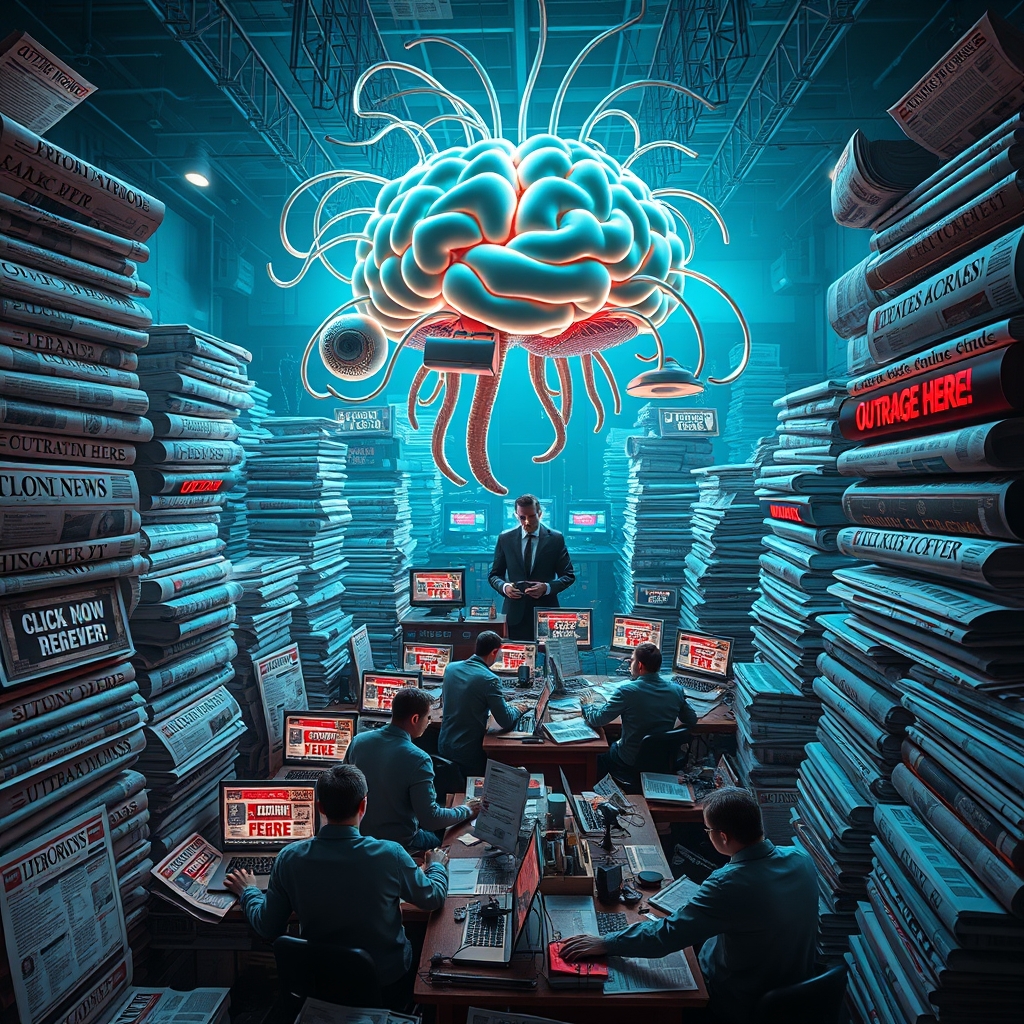
Ah, the news business—where the noble pursuit of truth collides spectacularly with the relentless pursuit of ad revenue. It’s a beautiful thing, really. One minute, you’re a journalist with a passion for holding power to account; the next, you’re a content creator optimizing for engagement metrics like your life depends on it. Because, let’s face it, in this economy, it kind of does.
The Death of Nuance (And the Rise of the Hot Take)
Remember when news was something you consumed to become an informed citizen? Pepperidge Farm remembers. Now, it’s more like a never-ending buffet of outrage, served with a side of confirmation bias. Nuance? That’s so 2005. Today, the news cycle moves at the speed of a Twitter scroll, and if you’re not first, you’re last—or at least, you’re not getting those sweet, sweet clicks.
Take, for example, the modern phenomenon of the “hot take.” It’s not enough to report the facts anymore. No, no. You need to package those facts in a way that makes people either love you or hate you—preferably both. The more polarizing, the better. After all, nothing drives engagement like a good old-fashioned internet pile-on. And if you can squeeze a few ads between the outrage and the inevitable apology (or non-apology), well, that’s just good business.
Journalism: Now With 100% More Algorithm
Gone are the days when editors decided what was newsworthy based on, you know, actual news value. Today, the algorithm is the editor-in-chief, and it’s got a PhD in psychology. It knows what makes you tick, what makes you angry, and—most importantly—what makes you click. And if you think that doesn’t influence the kind of stories that get written, you’re either naive or living under a rock.
Let’s not forget the rise of “churnalism,” where journalists are so pressed for time (and resources) that they regurgitate press releases like a human copy-paste machine. Why bother with original reporting when you can just rewrite a corporate PR statement and call it a day? Efficiency! And if you’re lucky, you might even get a byline out of it. Congratulations, you’re now a content factory worker.
The Illusion of Choice (And the Reality of Monopoly)
Oh, but we have so many news sources to choose from! There’s Fox, CNN, MSNBC, the New York Times, the Wall Street Journal, and a million digital upstarts vying for your attention. It’s a golden age of media diversity, right? Wrong. Behind the scenes, a handful of conglomerates own most of the outlets you consume, and they’ve got more in common than you’d think. Sure, they might disagree on the surface—one’s team red, the other’s team blue—but at the end of the day, they’re all playing the same game: maximize profits, minimize risk, and keep the shareholders happy.
And let’s not pretend that “independent” media is the answer. Sure, there are some fantastic independent journalists out there doing great work, but they’re swimming against a tide of corporate money, algorithmic suppression, and the sheer exhaustion of trying to compete with free content. Meanwhile, the big players keep consolidating, buying up competitors, and turning journalism into just another asset on the balance sheet. How quaint.
The Subscription Economy: Paywall or Perish
Remember when news was free? Ah, the good old days. Now, it’s all about subscriptions. “Support quality journalism,” they say. “Pay for the truth,” they plead. And hey, I get it—good journalism costs money. But let’s not pretend that paywalls are some noble solution to the industry’s woes. They’re a business model, plain and simple. And like all business models, they come with trade-offs.
For one, paywalls create a two-tiered system: those who can afford to pay for news and those who can’t. And let’s be real, the people who can’t afford it are often the ones who need reliable information the most. Meanwhile, the outlets that do offer free content are often the ones peddling sensationalism, misinformation, or outright propaganda. It’s almost like capitalism has a way of turning everything—even the pursuit of truth—into a luxury good.
The Future of News: A Dystopian Masterpiece
So what’s next for the news business? If current trends are any indication, we’re hurtling toward a future where AI-generated content floods the internet, deepfake interviews become indistinguishable from reality, and the line between news and entertainment is so blurred it might as well not exist. Oh, and let’s not forget the rise of “synthetic media,” where algorithms churn out personalized news feeds tailored to your biases, ensuring you never have to confront an uncomfortable truth again. Paradise!
And yet, despite all this, there’s still hope. Not because the industry is suddenly going to rediscover its moral compass, but because people are starting to see through the charade. They’re tired of the outrage machine, the clickbait, the endless cycle of manufactured drama. They want something real, something honest, something that doesn’t treat them like a pair of eyeballs to be monetized. The question is, will the news business evolve to meet that demand, or will it double down on the same old tricks until the whole house of cards comes tumbling down?
In the meantime, we’ll keep scrolling, keep clicking, and keep pretending that the news we consume is anything more than capitalism in a cheap suit. After all, what’s a little cognitive dissonance when there’s a perfectly good outrage cycle to feed?
You may also like
-
The News Business: Where the Only Thing More Infinite Than the Scroll Is Your Diminishing Faith in Humanity
-
The News Business: Where the Only Thing More Exhausting Than the News Cycle Is Pretending You Understand It
-
The News Business: Where the Only Thing More Predictable Than the Headlines Is Your Indignation
-
The News Business: Where Your Outrage is the Product and You’re the Unpaid Intern
-
The News Business: Where the Truth is a Commodity and Your Brain is the Market