
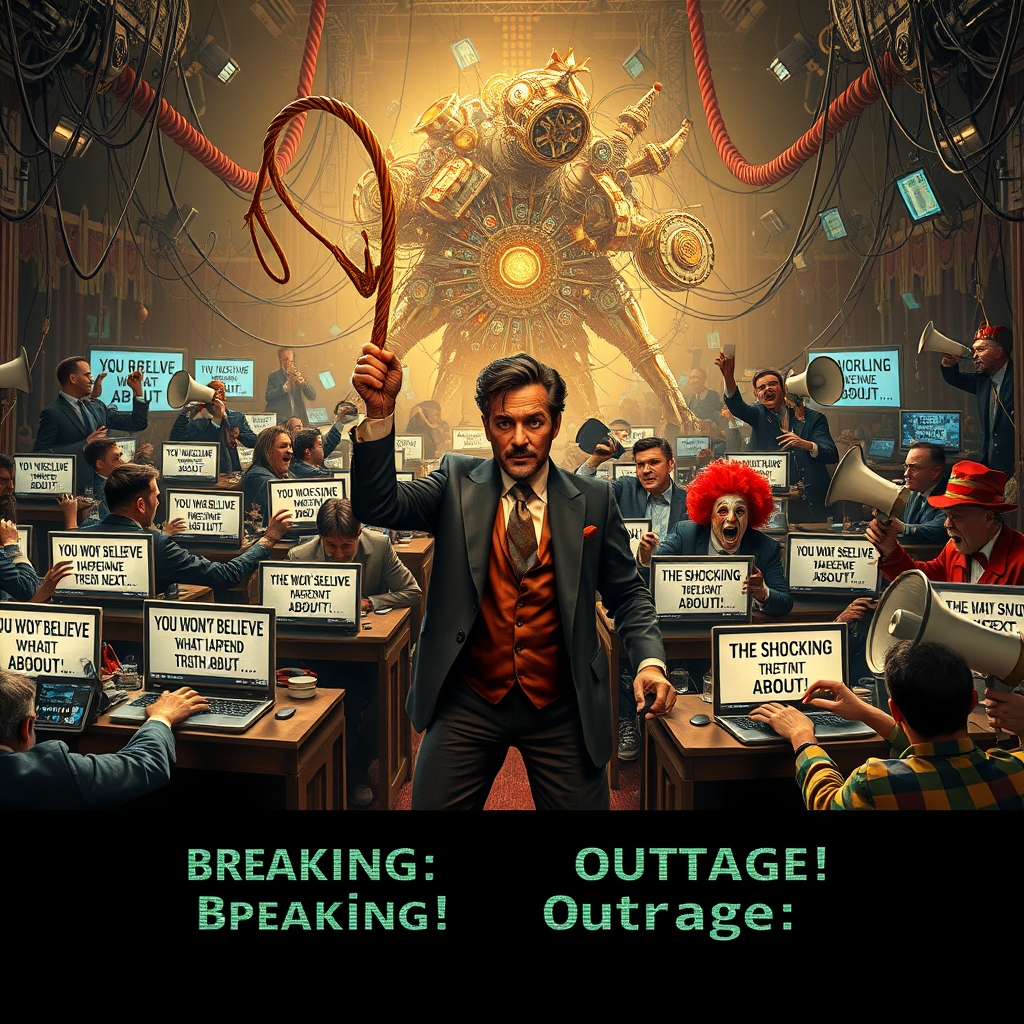
Ah, the news business—where the pursuit of truth is as noble as a knight’s quest, if the knight were a caffeine-addled intern racing against a deadline to churn out another listicle about “10 Celebrities Who Aged Like Fine Milk (Number 7 Will Shock You!)”. Welcome to the circus, folks, where the ringmaster is an algorithm, the clowns are pundits, and the lions are, well, the lions of Wall Street, roaring for more engagement metrics.
The Illusion of Choice: Pick Your Flavor of Bias
Gone are the days when news was a monolithic beast, a single voice echoing from the mountaintop of objectivity. Now, it’s a buffet of biases, where you can pick your poison: left, right, center, or that weird libertarian uncle who thinks Bitcoin will solve world hunger. The beauty of it? You don’t even have to leave your echo chamber. Why bother with facts when you can have a cozy blanket of confirmation bias, wrapped in the warm embrace of a news outlet that thinks exactly like you do?
It’s democracy in action, really. The freedom to choose which version of reality you’d like to subscribe to, delivered straight to your feed with a side of sponsored content. Because nothing says “informed citizen” like scrolling past an ad for a dubious supplement between two articles about the latest political scandal. The news business has mastered the art of making you feel informed while simultaneously ensuring you’re too distracted to notice the strings being pulled.
The Race to the Bottom: Who Can Outrage the Fastest?
In the grand tradition of capitalism, the news business has discovered that outrage is the ultimate renewable resource. Why report on nuanced policy debates when you can scream about the latest tweet from a washed-up celebrity? The formula is simple: take a kernel of truth, douse it in gasoline, light it on fire, and watch the clicks roll in. Bonus points if you can make it go viral before the facts even have a chance to put on their pants.
Journalism, once the watchdog of democracy, now resembles a pack of chihuahuas yapping at a mailman. The louder the bark, the more attention it gets, and attention is the currency of the realm. Never mind that the mailman is just doing his job—what matters is that the chihuahuas get their treats (or in this case, ad revenue). The news cycle moves at the speed of a toddler on a sugar high, and if you blink, you’ll miss the next manufactured controversy designed to keep you hooked.
The Algorithm Knows You Better Than You Know Yourself
Ah, the algorithm—the silent puppet master pulling the strings of modern news consumption. It knows what you like, what you hate, what makes you click, and what makes you rage-share. It’s like having a nosy neighbor who not only knows your business but also decides what business you should be paying attention to. And let’s be honest, it’s terrifyingly good at its job.
Remember when news was something you sought out? Now, it’s something that seeks you out, like a persistent ex who just won’t take a hint. The algorithm doesn’t care about truth, balance, or context. It cares about engagement, and engagement thrives on emotion—preferably the kind that makes you want to throw your phone across the room. The result? A news diet so tailored to your preferences that you might as well be living in a parallel universe where facts are optional and outrage is the main course.
The Death of Nuance (And the Birth of the Hot Take)
Nuance is dead, and good riddance. Who needs complexity when you can have a hot take so spicy it could double as a weapon? The news business has turned opinion into a spectator sport, where the goal isn’t to inform but to provoke. Pundits aren’t paid to provide insight; they’re paid to scream louder than the other guy. And if you can’t dazzle them with brilliance, baffle them with bullshit.
Gone are the days of investigative journalism, where reporters dug deep and uncovered truths that made powerful people squirm. Now, it’s all about the hot take, the think piece, the op-ed that reads like it was written by a caffeine-fueled AI with a grudge. Why bother with facts when you can have a take so bold, so contrarian, that it guarantees you a spot on the evening news? The news business has turned into a gladiatorial arena, where the only rule is that there are no rules—and the audience loves it.
The Sponsors Are the Real Editors
Let’s not forget the real power players in the news business: the advertisers. They’re the ones signing the checks, and they’ve got a vested interest in making sure the news doesn’t rock the boat too hard. After all, you can’t sell luxury cars or miracle diets if the public is too busy being outraged about, say, income inequality or climate change. So, the news becomes a carefully curated experience, where the line between editorial content and sponsored drivel is so blurry it might as well not exist.
Native advertising, sponsored content, branded journalism—call it what you will, but it’s all the same thing: a wolf in sheep’s clothing. The news business has perfected the art of making ads look like news, because why should you be able to tell the difference? If it’s got a headline, a byline, and a stock photo, it must be news, right? Wrong. It’s just capitalism in a cheap suit, and it’s coming for your attention span.
The news business isn’t broken—it’s working exactly as intended. It’s a machine designed to keep you engaged, outraged, and clicking, all while lining the pockets of the people who own the machine. The question isn’t whether the news is biased or sensationalized; the question is whether we, the audience, are willing to keep feeding the beast. Because as long as we’re clicking, sharing, and scrolling, the show will go on. And what a show it is—equal parts tragic, hilarious, and utterly predictable. Enjoy the circus, folks. You’re paying for the tickets.
You may also like
-
The News Business: Where the Only Thing More Infinite Than the Scroll Is Your Diminishing Faith in Humanity
-
The News Business: Where the Only Thing More Exhausting Than the News Cycle Is Pretending You Understand It
-
The News Business: Where the Only Thing More Predictable Than the Headlines Is Your Indignation
-
The News Business: Where Your Outrage is the Product and You’re the Unpaid Intern
-
The News Business: Where the Truth is a Commodity and Your Brain is the Market